When authors don’t share raw data, digitize the published figures. Accepted under the Cochrane Handbook and PRISMA 2020 if the method is reported and the data sanity-checked against summary statistics in the text.
For systematic reviewers, meta-analysts, and HTA practitioners — when digitization is appropriate, what the frameworks expect, and three worked examples (Kaplan-Meier reconstruction, forest plot extraction, dose-response).
When digitization is appropriate
Digitize when (1) the analysis requires data the text doesn’t tabulate, (2) the corresponding author hasn’t responded within a reasonable window (Cochrane: two reminders over four to six weeks), and (3) the figure is good enough to extract with documentable accuracy.
If raw data sits in supplementary materials, the trial registry (ClinicalTrials.gov, ANZCTR), or an institutional repository — use it. A clean CSV beats any digitization.
If summary statistics (means, SDs, medians, IQRs) appear in tables or text, transcribe. Don’t digitize what’s already published as numbers.
Digitization is right when the question requires time-to-event data, dose-response curves, or distributional information that only exists in the figure. Most KM reconstruction falls here.
What PRISMA and Cochrane say
Both frameworks accept digitized data. Reporting burden is non-trivial.
PRISMA 2020 (item 10) requires describing methods used to collect data from reports, including automation. Report tool name, version, who extracted, and whether independently verified.
Cochrane Handbook (Chapter 5) is more specific. Accepts digitization for survival curves and other figure-only data, requires dual independent extraction with reconciliation, and recommends comparing extracted summaries against any in the text. Report significant discrepancies as a limitation.
MOOSE (observational meta-analyses) is aligned with PRISMA: report method, tool, verification.
ISPOR’s good practice for indirect treatment comparisons explicitly accepts digitization of KM curves using the Guyot et al. (2012) algorithm when IPD is unavailable. Guyot below.
The general workflow
Mechanics match any chart extraction — upload, place points, calibrate, export. Systematic-review additions sit around those steps.
- Decide what to extract based on the analysis plan. Don’t digitize speculatively.
- Pre-register the method in the protocol if registered (PROSPERO, OSF).
- Two reviewers extract independently for every included study.
- Reconcile discrepancies by re-extraction or discussion.
- Validate against summary statistics in the original report.
- Archive alongside the source figure (XLSX with chart embedded is useful — see chart screenshot to Excel).
Four-step mechanics in our pillar guide.
Worked example 1: Kaplan-Meier curve reconstruction
The most common use in systematic reviews is reconstructing IPD from a published KM curve. Standard method: Guyot et al. (2012), implemented in R packages like IPDfromKM.
The Guyot et al. method in one paragraph
Digitize the survival curve. Combine those coordinates with the numbers-at-risk table almost every published KM curve includes below the X axis. Run the algorithm: it reconstructs times and event indicators consistent with both the curve and the numbers at risk. Output is an IPD-equivalent dataset usable in Cox regression, flexible parametric models, or any time-to-event analysis.
Worked walkthrough
Hypothetical phase 3 oncology trial. KM curve from month 0 to 36. Two arms: experimental (n=240), control (n=238). Numbers at risk at months 0, 6, 12, 18, 24, 30, 36.
Step 1: render at 300 DPI. PDF? See our PDF chart guide.
Step 2: upload. Place points along the experimental arm at every visible step. For dense curves, use the color picker.
Step 3: calibrate. X: 0 to 36 (months). Y: 0 to 1.0 (survival). Labels “Time (months)” and “Survival probability” — carry through to XLSX.
Step 4: export (time, survival) for experimental. Repeat for control.
Step 5: feed both curves plus numbers-at-risk into IPDfromKM::getIPD() (R) or equivalent. Output: two reconstructed datasets, one per arm, each row a (time, event_indicator) pair.
Step 6: validate. Compute median survival from your IPD and compare against the trial’s text. Abstract says 18.5 months and yours says 16.2? Digitization problem (likely Y-axis calibration). Fix and re-run.
Reconstructed IPD lets you fit flexible parametric models, run an NMA on time-varying hazard ratios, or extrapolate beyond follow-up.
Common KM digitization pitfalls
Censoring tick marks. Don’t click them as data — they’re censoring indicators. Guyot infers censoring from numbers-at-risk discrepancies.
Curves that touch zero. Implies every patient had an event, rarely true. If N_at_risk is non-zero at the final timepoint, the curve should not be at zero.
Wrong reference at t=0. Confirm S(0) = 1.0 and X = 0. If the figure starts later (a “landmark” analysis), report that.
Digitizing KM curves for a review? The extractor supports the color-picker workflow that handles dense step curves well. Export to XLSX so the chart sits next to the data for dual-reviewer verification.
Worked example 2: forest plot extraction
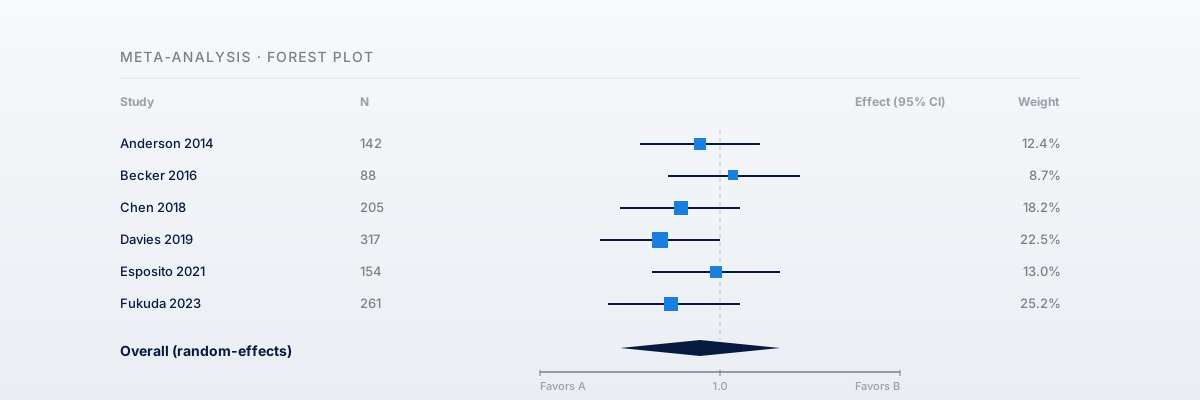
Forest plots are easier — discrete values (point estimates and CI bounds), not continuous. But the encoding is precise: a 0.5mm shift in a CI bar represents real difference in meta-analysis weights.
Walkthrough
Hypothetical forest plot of 12 trials on a risk ratio scale.
Step 1: render at 300 DPI.
Step 2: upload. Each row has a point (estimate square) and a horizontal line (95% CI). Three values per trial: lower CI, estimate, upper CI.
Step 3: place three points per trial — each end of the CI line, plus the square’s center. Group as “trial_X”.
Step 4: calibrate X. Forest plots often use log for ratio measures. Calibrate at two visible powers of ten (e.g., 0.1 and 10). Y is categorical — use trial labels manually.
Step 5: export. Three rows per trial. Pivot so each trial is one row with lower, estimate, upper. Compute SE per trial from (log(upper) - log(lower)) / (2 * 1.96). Inputs for a fresh meta-analysis or sensitivity analysis.
Common forest plot pitfalls
Diamond at the bottom. The summary diamond is the meta-analytic estimate, not a trial. Skip it.
Sub-group lines. Sub-group summary rows look like trial rows but represent pooled estimates. Skip or extract separately and label clearly.
Square size encodes weight. Don’t extract it — extract the center and let your re-analysis compute weights from the SEs.
Worked example 3: dose-response curve
Dose-response work — toxicology, pharmacology, environmental epidemiology — typically requires curve shape plus confidence bounds.
Walkthrough
Hypothetical curve, dose (mg/kg, log scale, 0.1–100) vs response (% effect, 0–100%). Sigmoid fit plus 95% confidence band.
Step 1: render at 300 DPI.
Step 2: upload. Three things to extract: central curve, upper band, lower band.
Step 3: place points. Central curve: click at evenly-spaced X (every quarter-log: 0.1, 0.18, 0.32, 0.56, 1.0, …). Bands: use the color picker — bands are typically a lighter shade of the curve color, which the picker handles with a moderate tolerance.
Step 4: calibrate. X log: 0.1 and 100, type logarithmic. Y linear: 0 and 100. Labels “Dose (mg/kg)” and “Response (%)” — propagated to XLSX.
Step 5: export. Three (dose, response) series. Compute SE per dose as (upper - lower) / (2 * 1.96).
Step 6: validate. The paper likely reports an ED50. Compute from your curve and compare. Within a few percent means good extraction.
Common dose-response pitfalls
Linear axis mistaken for log. Rare but happens — a linear X axis with log-spaced ticks. Confirm from the caption.
Truncated Y axis. Some figures show Y from 20% to 80% to zoom in. Note in methods — doesn’t affect calibration but matters downstream.
Reporting standards for your methods section
A minimal reporting block:
Where individual patient data was unavailable, time-to-event outcomes were reconstructed from published Kaplan-Meier curves using the algorithm of Guyot et al. (2012). Curves were digitized in DataFromChart (version 1.x), with two reviewers (initials, initials) extracting independently; discrepancies above 2% in any (time, survival) pair were reconciled by re-extraction and consensus. Reconstructed median survival was validated against text-reported medians; agreement was within ±0.5 months across all included studies.
Adjust for your tool, reviewers, tolerance, and validation outcome. The structure (method, tool, dual extraction, reconciliation, validation) is what reviewers expect.
PRISMA: item 10. Cochrane: “Data extraction and management.” Cite the algorithm paper (Guyot et al. 2012 for KM) — methods reviewers know these by name.
Reproducibility tips
Reproducible only if someone else can run the same workflow and get the same numbers. Three practices.
Archive the source figure with the data. XLSX with chart embedded is convenient. CSV-only workflows need a separate archived PNG.
Record the calibration values. If you calibrated X at 0 and 36 months, write it down. Cochrane expects this in sensitivity analysis.
Use a fixed tool version and report it. If the algorithm changes between runs, data may shift. Pin a version.
Run dual independent extraction. Two reviewers should agree within a few percent. Diverge by 5%+, the figure is ambiguous — that’s a limitation.
Four-step mechanics in our graph image extraction guide.
Tool choice for meta-analysis work
Two tools dominate: WebPlotDigitizer and DataFromChart. Comparable accuracy on clean images. Choice is workflow.
WebPlotDigitizer is the name most methods reviewers expect — field standard since the early 2010s, cited in thousands of methodology papers. Use when reviewer familiarity dominates.
DataFromChart produces XLSX with chart and axis labels embedded, simplifying dual-reviewer comparison and archiving. Color-picker auto-extraction handles dense KM curves faster than manual clicking. Use when reproducibility and reviewer comparison matter more than name recognition.
Full landscape — including five other tools — in our WebPlotDigitizer alternatives roundup.
CTA
If you’re partway through a systematic review with figure-only data, the extractor covers digitization end-to-end and produces XLSX suitable for dual-reviewer archiving. Open one of your included studies’ figures and try the workflow.
FAQ
Is digitized data acceptable to peer reviewers?
Yes, when the method is reported transparently and the data validated against summary statistics in the source. Cochrane and PRISMA explicitly accept it; ISPOR’s good-practice for indirect comparisons explicitly endorses KM digitization.
How accurate is reconstructed IPD from Kaplan-Meier curves?
Done carefully (Guyot, dual extraction, numbers-at-risk validation), reconstructed IPD reproduces median survival within 0.5 months and hazard ratios within 5% of true IPD in most validation studies. Accuracy degrades with low-resolution figures, missing numbers-at-risk, or heavy late censoring.
Do I need dual extraction?
Cochrane requires it. PRISMA recommends it. For non-Cochrane reviews, single is acceptable if you validate against text-reported summaries, but dual is best practice and not much more work.
Which tool should I cite in the methods?
Cite by name and version (e.g., “DataFromChart v1.x” or “WebPlotDigitizer v4.x”). For KM, also cite the algorithm paper (Guyot et al. 2012, BMC Medical Research Methodology).
What if the corresponding author has agreed to share data but hasn’t sent it yet?
Document the request and timeline in your protocol. If data arrives, use it. If not within your pre-specified window, proceed with digitization and note the unsuccessful request in limitations.
Can I use digitized data for a network meta-analysis?
Yes. Digitized KM curves reconstructed via Guyot are routinely used in NMAs of time-to-event outcomes, especially oncology HTA. ISPOR’s NMA good practice endorses the approach.
How do I handle figures with overlapping confidence bands?
Extract each band separately using the color picker. Where bands overlap, pixel color is a blend — set tolerance carefully so the picker captures the blend as one or the other, then visually inspect for misallocation.
What about Bayesian meta-analyses?
Identical digitization step. Bayesian methods (flexible parametric survival models with informative priors) consume the same reconstructed IPD as frequentist methods.
Is there a difference between journal PDFs versus website images?
Mechanically no — both reduce to “render or screenshot, then extract.” Journal PDFs are usually higher resolution; web-hosted figures are often optimized for screen and lose detail. Prefer the PDF source.
Where does my extracted data live after the review is published?
Archive the XLSX (with embedded chart) plus calibration values in a data repository (Dryad, Zenodo, OSF). PRISMA 2020 item 27 (data, code, materials availability) expects this disclosure.
Try it on your own chart
Create a free account to upload an image or PDF, calibrate the axes, and export CSV or XLSX. Or start with a built-in sample without signing in.
Open the extractor